BACKGROUND– LOVERS PLUS
TEAMWORK. The emergency services are all team “sports.” And, one thing every successful team depends on is a well-defined understanding of the functions and tasks that need to be completed, and a clear definition of who is expected to complete them. Not everybody gets to play the “starring” role. Generally, part of the team is focused on the “primary mission”—but, the rest of the team has other work to do. U.S. Army General John Pershing (himself, a long-time cavalry officer) once said, “the cavalry doesn’t win battles; the cavalry performs reconnaissance, softens-up the enemy and protects the foot soldiers– so they can win battles.”
TEAMWORK IN THE FIRE SERVICE. A similar analogy can be drawn in the fire service; generally, at every emergency one person, the incident commander (or a cohesive, integrated group) is calling the shots, and one group focuses on control of the primary threat, while others (much like the cavalry) perform supportive operations, such as monitoring and controlling threats to the primary crew(s), enhancing the safety and efficiency of their operations and controlling secondary threats and priorities. At fires, it is usually the “engine” [or pumper] companies that deal with the primary threat (fire) and the “trucks” [ladders, towers, etc.] and other special units [like rescue and squad units] that perform the support operations. Trucks, Rescues and Squads are the cavalry of the emergency services.
“TRUCK WORK”– LOVERS PLUS. For many years the traditional definition of hook and ladder or “truck company” responsibilities was summarized by the acronym LOVERS:
- Laddering (and Elevated Operations)
- Overhaul
- Ventilation
- Entry
- Rescue
- Salvage (and General Property Conservation)
In more recent times, technological developments have added to the truck company’s duties. In preparation for its original 1985 course on “Fireground Support Operations,” at the University of Missouri Fire and Rescue Training Institute’s summer fire school, the Fire Safety Group, expanded on the acronym to include PLUS:
- Power Supply
- Lighting
- Utility Control (and Control of Other Environmental Hazards and Systems)
- Special Functions
FIREGROUND SUPPORT OPERATIONS (FSO). In 1984, to say that there were some ladder trucks but few “truck companies” in the Midwest wasn’t much of an exaggeration. In fact, nationally, truck companies seemed to have fallen on hard times; truck houses were being closed in major cities, the activity level in truck companies in suburban departments was sometimes so slow that they viewed (rightly or wrongly) as retirement homes. Volunteer departments in some areas, left the trucks in quarters claiming “we don’t have the manning”– the public, city administrators– even fire departments, themselves– had lost sight of the value of truck company operations and ladder trucks.
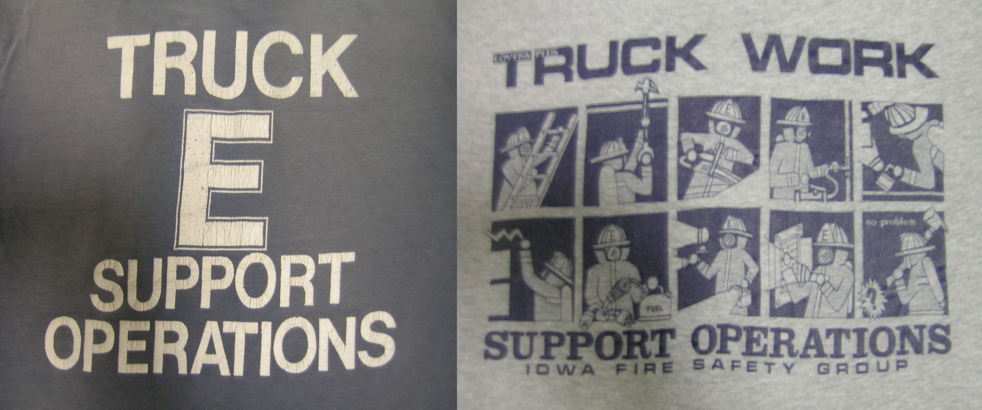
In this context, a group of firefighters in Iowa (yes, of all places), with strong truck company inclinations, formed what was called the Fire Safety Group– FSG:
- Greg Mundy, Assistant Chief (Ret.), Irmo (SC) Fire District
- Dean Hutt, Chief (Ret.), Indianola (IA) Fire Department
- Phil Harris, Deputy Chief (Ret.), Ames (IA) Fire Department
- Doug Baber, Former Chief, Hartford (IA) Fire Department
- Fred Malven, Assistant Chief, Nevada (IA) Fire Department
Even though he only occasionally had the opportunity to teach the support operations class with the others, another person (and spiritual leader) was the catalyst for the whole thing, creating opportunities and making contacts:
- Andy Levy, North-Central Regional Coordinator, Maryland Fire and Rescue Institute (Former Assistant Chief, Hyattsville (MD) Volunteer Fire Department)
FSG’s sole reason for being was to develop and deliver courses at regional and state fire schools titled (and focusing on) Fireground Support Operations (FSO). The implied sub-title was “Truck Company Operations for Departments With and Without a Ladder Truck.” While some dedicated truck companies might take exception to describing their work as “support operations,” here it is used with great respect. Virtually every fire department imagines itself delivering the most “aggressive” fire attack anywhere. Maybe; maybe not. But, be that as it may, few departments can claim the kind of comprehensive truck and squad work (support operations) that turn such self-perceptions into reality. The ideas that develop around discussions of support operations– emphasizing the importance of training and practice with hand tools, power tools, new technology, and creative problem-solving (all long-standing truck company traditions)– are the real stuff of which safe, efficient fire departments are formed.
OTHER EARLY INFLUENCES. Iowa is not broadly viewed as the epicenter of fire service leadership and innovation. However, that perception would be clearly justified for anyone who met Mark Farren, until recently the Chief of Colo (Iowa) Fire and Rescue. He was a far sighted, progressive leader with an innate ability to transform adversity into opportunity, people into teams (in the best and fullest sense of the word), and the ordinary into the exceptional and memorable. And, he put a smile on every project he visited, including this one.
Besides Andy, Mark and FSG colleagues, [too] rare visits with one last person were influential in shaping early beliefs concerning truck operations, fire service leadership and the whole field (as it should be):
- Donald “Doc” Moltrup, Chief (Ret.), Hyattsville Volunteer Fire Department
Doc served the Hyattsville Volunteer Fire Department as the kind of leader one imagines every Chief to be (but, seldom finds to be the case); he has always seemed to have a huge influence on everything without ever being obtrusive. Thanks, for everything, Doc.
Of course, on a broader front, dedicated fire instructors had been doing truck company classes for years and these helped inspire many of FSG’s contributions. Particularly noteworthy as an early influence was Harold Richman and his “Truck Company Fireground Operations” book, based on his long, active career in the Maryland fire service. In the early years, Richman and his book provided the start-up instructions for FSO.
Even in its own time, the FSO class wasn’t unique. Several individuals and groups were trying to expand attention to ladder company operations. LAFD’s John Mittendorf was a great example. He, along with R.R. Ramirez, were key figures in popularizing positive pressure ventilation and attack (PPV and PPA) tactics. Mittendorf, himself, has done hundreds of detailed truck company classes and authored his “Truck Company Operations” book. There were always plenty of classes on individual LOVERS PLUS functions, as well. Among others, David Moltrup and John McNeese, from Montgomery County Maryland, traveled widely with a broadly-based course on forcible entry methods– their hands-on approach had a big impact on FSG’s course. And, in the late 80s and 90s, several journal authors were concurrently writing new articles spotlighting the important contributions of effective truck work and cautioning that the ladder company might be headed for obscurity.
THE NEW MOVEMENT– NEW INFLUENCES. Now, a current generation of dedicated, inventive young troops continue the tradition, focusing on one, several, or all of the traditional LOVERS PLUS functions. As time permits, some examples of their activities and influences on this author will, hopefully, be summarized here. For now, a few deserve at least name reference for having been sources of new energy and insight.
- Tim Nemmers, Engineer, Truck 3 (now Lieutenant, Training), Des Moines (IA) Fire Department
- Jerry Smith, Firefighter, Rescue 1, Baltimore (MD) Fire Department
- Tim Brozowski, Engineer, Rescue 1 Baltimore (MD) Fire Department
- Randy Jones, Lieutenant, Engine 5 (now Ladder 1), Des Moines (IA), Fire Department
- Robert James, Firefighter, Squad 3 (now Squad 2), Frederick City (MD) Fire Department
CURRENT COURSES. Several of the old crew have shifted their interests in other directions. However, among other “truck company”-related classes, updated (and, frequently, more focused, specialized) versions of the original Fireground Support Operations class are still being delivered by teams including founding FSG members. In South Carolina, retired Irmo Fire District Assistant Chief Greg Mundy and his associates still present courses evolved from the initial support operations concept. And, in Iowa, Assistant Chief Fred Malven and other members of the Nevada Community Fire Department deliver a variety of one and two-day courses emphasizing the LOVERS PLUS functions:
- Tracy Tope, EMT (former Captain)
- Dean Tope, Assistant Chief
- Joe Mousel, Captain
- Jason Corbin, Firefighter
- David Donnelly, Lieutenant
- Noah Reyman, Firefighter
- Gary Howard, Firefighter
HOOK + LADDER UNIVERSITY? A bit pretentious? Maybe. But, if you think of universities not as sources of wisdom, but rather as places to share, debate, refine and apply insight, it seems appropriate to the goals of this site.